Thursday, March 29, 2007

LEZINGENCYCLUS IRAK

De komende maanden zullen verschillenden deskundigen zullen hun licht laten schijnen op diverse aspecten van de oorlog in Irak. Hieronder de sprekers, hun onderwerpen en de data waarop zij spreken.


Woensdag 4 april
Mehdi Amineh: Iraq in global politics: past, present and future (voertaal Engels)


Donderdag 12 april
Robert Soeterik: Irak in het veelbewogen jaar 2006


Donderdag 19 april
Kees Homan: Irak, de uitdaging van complexe irreguliere oorlogvoering


Donderdag 26 april
Paul Aarts: Irak, de achtertuin van Iran?


Donderdag 3 mei
Mariwan Kanie: De toekomst van Iraaks Koerdistan; een eigen staat of weer ellende?


Tijd 20.00 tot 21.00 gevolgd door een vragenuurtje
Locatie PC Hoofthuis (UvA), zaal 104 in de Spuistraat Amsterdam.

Toegang gratis

Mochten er nog vragen zijn, bel of mail dan naar Frans van Rumpt: vanrumpt@hotmail.com.

Wednesday, March 21, 2007

de nederlands arabische kring – amsterdam

presenteert op woensdag 28 maart in de levante


VIDEO ART IN BEIROET

DOOR NESRINE KHODR

Noem Libanon, noem Beiroet en de kans bestaat dat de clichés je om de oren vliegen. Van het Parijs van het Midden-Oosten tot een bolwerk van Hezbollah-strijders. Wat buiten kijf staat is dat Libanon al eeuwenlang voor menig kunstenaar een onuitputtelijke bron van inspiratie is.

Zo ook voor de Libanese Nesrine Khodr. Ze studeerde geschiedenis aan de American University of Beirut en Europese Studies aan de Universiteit van Edinburgh in het VK. Vanaf 1998 regisseerde ze verschillende korte films en documentaires. Haar werk: Of seduction, 32’(1998), Ain ‘al Hamra (Red is the colour of my eye), 23’(2000), Downtown Amman-Urbanportraits, 18’(2003), Last Fall, 2’30” (2003) en meer recent Enclosures, 22’(2004) en L’avancée, 14’(2006). Khodr’s videokunst was onder meer te zien in het gerenommeerde Tate Modern in Londen, maar ook Tokio, Berlijn, Parijs en Sao Paolo. Deze avond zijn twee van haar films te zien, en omdat Nesrine Khodr momenteel in Nederland is, zal zij deze films persoonlijk komen toelichten.

Synopsis ‘Red is the colour of my eye’
Beirut, Hamra Street. 2000. I have lived there since my childhood. The street has undergone many changes over the years. Through two protagonists we embark on a journey of lost memories and present emotions.

Synopsis ‘Of seduction’
‘Of seduction’ evokes the meanders of desire, of seduction and of love by giving word to women of different generations. One of those women is Soraya, a young woman who has chosen the one on whom she is to exert her seductive powers, a man of which we will hardly see more than his silhouette, his back, his hands.

Locatie De Levante, Hobbemastraat 28, 1071 ZC Amsterdam

Datum woensdag 28 maart

Tijd 20.00 - 22.00

Voertaal Engels

Entree EURH 2.50, NAK-leden gratis op vertoon van lidmaatschapkaart

Reserveren verplicht i.v.m. de beperkte ruimte.

Reserveringen & info
sharida mohamedjoesoef / 06–481 84 228
de levante
info@delevante.org / 020 - 671 5485.

De Levante is te bereiken via trams 2 en 5, halte Hobbemastraat, langs het Rijksmuseum tot het water (Hobbemakade), op de hoek rechts.

Sunday, February 04, 2007

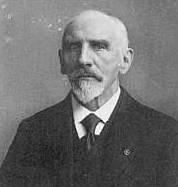
CHRISTIAAN SNOUCK HURGRONJE

ARABIST, SCHOLAR OF ISLAM (1857-1936)


P R E S S R E L E A S E

On February 8, 2007 it is exactly 150 years ago that the Dutch islamologist and scholar of Arabic, Christiaan Snouck Hurgronje was born. Snouck Hurgronje has become famous by his journey to Mecca in 1884-1885. In his study (which he wrote in German)
Mekka he has recorded the results of his research in Mecca.

To commemmorate his legacy a
n academic workshop will be organised at Leiden University on February 16, 2007, which will be devoted to Snouck Hurgronje’s life and work under the title ‘Scholarship in action’. This workshop is organized and funded by the Faculty of Arts and the Research School of Leiden University.On the same day the Saudi-Arabian architect Dr. Sami Angawi will deliver the third Snouck Hurgronje lecture under the title ‘How can Mecca be saved?’ This lecture is organized by the Foundation ‘Oosters Instituut’. Please visit the website for a survey of other activities in 2007 relevant to Christiaan Snouck Hurgronje can be found as well.

At the start of this year the renown Leiden publisher, Messrs. Brill, has republished the English translation of this work. A Dutch version of the book will appear later in 2007. It contains an extensive introduction on Snouck Hurgronje’s life and work in Jeddah and Mecca, which is based on many as yet unknown documents.

In the period 1889-1906 Snouck Hurgronje lived and worked in the Dutch East-Indies (Indonesia), as an adviser on Islamic and Arabian affairs to the colonial government. In 1893-1895 he published his two-volume study on Aceh (De Atjehers). An English translation of this work appeared in 1906.In 1903 he published Het Gajoland en zijn bewoners (‘The Gajoland and its inhabitants’). His ‘Official Advices’ were posthumously published (1957-1965). These are an important primary source for our knowledge of the development of Islam in the Dutch East-Indies/Indonesia in the end of the 19th and the beginning of the 20th century.

From 1906-1927 Snouck Hurgronje held the chair of Arabic at Leiden University. In 1922 he was ‘rector-magnificus’ (chancellor) of Leiden University. Snouck Hurgronje is considered as the founder of the academic study of Islamic law. On this subject, as on many other subjects, he has published pioneering studies. Many of these have recently been translated into Indonesian. A great number of his ideas about attitudes towards and contacts with Islam and Muslims have still relevance today.

Snouck Hurgronje’s ethnographical objects (mostly from Mecca) are now kept in the National Museum of Ethnology in Leiden. His complete library (many thousands of books, manuscripts and documents) are kept in Leiden University Library. His magnificent house on Leiden’s most prestigious canal, the Rapenburg, is now the seat of the Leiden University Fund.

Leiden, 31 January 2007
Prof. Dr. Jan Just Witkam (j.j.witkam@let.leidenuniv.nl)
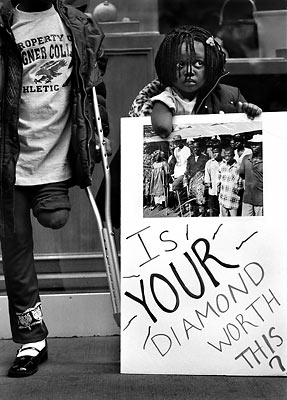
BLING BLING BECOMES BLING BANG

'The ancient Greeks believed that diamonds were slivers of stars that had fallen to earth. Others claimed that they were the tears of gods. According to yet another legend there was an isolated valley somewhere in Central Asia that was sown with diamonds and guarded by birds of prey and sinister snakes.' (Gassan Diamonds)

True, legends only telling part of the history of the diamond. But what then is the other part? Diamonds coming about as the result of scorching heat and enormous pressure under the crust of the earth is one story...and a bit one-sided. Logical, because it is the rational scientific explanation given on the website of Gassan Diamonds in Amsterdam. one of the oldest diamond houses in the Netherlands.


For my newspaper Dagblad De Pers, I contacted Benno Leeser, the director of Gassan Diamonds. He did not report any drop in sales after the release of the film, saying only few people asked questions. In the US, however, the diamond trade has been under pressure for quite some time now. Severe competition from low-wage countries is one the main reasons, although the release of Blood Diamond has not done the diamond industry much good either.

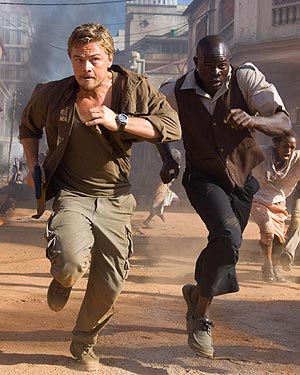
Already the film has become controversial, with people in the diamond trade claiming that Blood Diamond is a far cry from reality. I went to see it last night and was surprised that, although it was released only last week, it wasn't a crowd puller. Dicaprio shows he is more than a pretty face. The story touches on child soldiers, the blood trail of conflict diamonds and the hyprocrisy of us here in the west wanting to get our hands on such dazzling jewels. Below you will find the story line taken from the official moviesite. And make sure to watch the trailer and then of course the film itself.

Set against the backdrop of the chaos and civil war that enveloped 1990s Sierra Leone, "Blood Diamond" is the story of Danny Archer (Leonardo Dicaprio, an ex-mercenary from Zimbabwe, the former Rhodesia), and Solomon Vandy (Djimon Hounsou), a Mende fisherman. Both men are African, but their histories and their circumstances are as different as any can be until their fates become joined in a common quest to recover a rare pink diamond, the kind of stone that can transform a life...or end it.

Solomon, who has been taken from his family and forced to work in the diamond fields, finds the extraordinary gem and hides it at great risk, knowing if he is discovered, he will be killed instantly. But he also knows the diamond could not only provide the means to save his wife and daughters from a life as refugees but also help rescue his son, Dia, from an even worse fate, as a child soldier.

Enter Maddy Bowen (Jennifer Connelly), an idealistic American journalist who is in Sierra Leone to uncover the truth behind conflict diamonds, exposing the complicity of diamond industry leaders who have chosen profits over principles. Maddy seeks out Archer as a source for her article, but soon finds it is he who needs her even more. With Maddy's help, Archer and Solomon embark on a dangerous trek through rebel territory. Archer needs Solomon to find and recover the valuable pink diamond, but Solomon seeks something far more precious...his son.


the Blood Diamond international trailer

Saturday, January 20, 2007

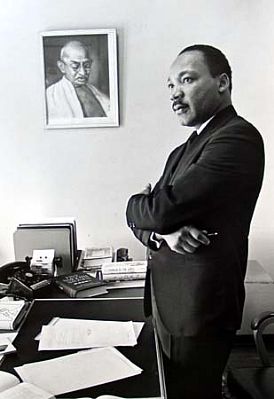
De erfenis van Gandhi en King

donderdag 18-01-07, SpitsNet

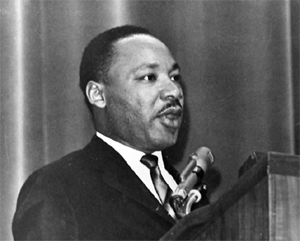
Alles wat Mahatma Gandhi en Martin Luther King deden, stond in het teken van geweldloos verzet. Hun nazaten, Tushar Gandhi en Yolanda Denise King, zijn in Nederland om die boodschap uit te dragen.

Door Floris Akkerman

AMSTERDAM -- De invloed van Mahatma Gandhi en Martin Luther King is in de wereld nog altijd voelbaar, zeggen achterkleinzoon Tushar Gandhi (47) en dochter Yolanda Denise King (51) in een Amsterdams hotel.

Tushar: "Het zijn donkere dagen waarin we verkeren. Er is veel geweld in de wereld. Zelfs een tandenborstel in het vliegtuig wordt als moordwapen gezien. Deze periode moeten we overleven. De hoop op een betere toekomst komt niet uit de loop van een geweer, maar uit het niet gebruiken van geweld bij conflicten. Beide mannen werden vermoord, maar hun gedachte om geen geweld te gebruiken leeft voort."

Yolanda: "Ik reis veel. Ik zie hoe de mensen met mijn vader in gedachten elkaar motiveren en inspireren. Dat zorgt voor humaniteit en bij mij voor optimisme."
Tushar en Yolanda, die elkaar vijf jaar kennen, zijn gisteren neergestreken in Nederland. Zij zijn niet de enige twee nazaten van wereldleiders die hier komen. De zoon en dochter van de ontvoerde Colombiaanse presidentskandidate Ingrid Bétancourt, de kleindochter van de voormalige Joegoslavische leider Tito en de zoon van de Zuid-Afrikaanse activist Steve Biko komen vandaag aan in Nederland.

Zij geven morgen workshops op het jongerenevenement B the change in Maastricht, waar jongeren zich inzetten voor een betere samenleving. De nazaten moeten hen inspireren en de lessen van hun beroemde familieleden overbrengen.

Met geweldloos verzet zorgden Mahatma Gandhi en Martin Luther King voor veranderingen in hun maatschappij. Martin Luther King verzette zich in de jaren vijftig en zestig tegen rassenscheiding in de Verenigde Staten. Gandhi probeerde in de eerste helft van de vorige eeuw de verschillen te overbruggen tussen de kasten in India, richtte zich op verzoening tussen hindoes en moslims en was de leider in de Indiase onafhankelijkheidsstrijd.

Wat zouden Mahatma Gandhi en Martin Luther King morgen tegen de jongeren hebben gezegd? Yolanda: "Dat jongeren voor veranderingen moeten zorgen in hun eigen wereld. Ze moeten liefde, compassie en harmonie tonen naar hun eigen omgeving. Hun familie en vrienden. Dat is de enige manier om voor veranderingen te zorgen. Dat moeten ze onthouden."

Tushar: "Jongeren denken dat ze niet voor veranderingen kunnen zorgen. Ze hebben er vaak geen vertrouwen in dat ze dat kunnen. Maar als één persoon zich positief inzet dan helpt dat de rest van de wereld. Jongeren moeten hun best daarvoor doen. Het geloof daarin is belangrijk."

Museum

De denkbeelden van Mahatma Gandhi hebben Martin Luther King sterk beïnvloed en ook voor Yolanda was de Indiër voortdurend aanwezig. "Thuis was er altijd een foto van Gandhi. Die stond prominent tussen andere familieportretten in. Je kon er niet omheen. Voor mijn vader waren twee mensen heel belangrijk: Jezus Christus en Mahatma Gandhi. Zij vormden zijn denken. Zijn filosofie. Van Gandhi leerde hij om geen geweld te gebruiken."

Omgekeerd volgde de familie Gandhi de verrichtingen van Martin Luther King. "Dokter King was een keer voor een driedaags bezoek in India", vertelt Tushar. "Toen hij op het vliegveld aankwam, wilde hij meteen naar het Gandhimuseum. Een plek waar mijn overgrootvader geregeld kwam.

Speciaal voor King werd een kamer geopend die nog helemaal intact was gebleven. Dokter King ging zitten en vroeg om alleen gelaten te worden. Hij smeekte de curator om ook na sluitingstijd daar te mogen blijven. Hij voelde zo dat hij de kracht van Mahatma Gandhi tot zich kon nemen. Aan het eind van elke dag wilde hij terug naar het museum."

Yolanda kijkt verrast en lachend op: "Dat is voor het eerst dat ik dit verhaal hoor. Toen mijn vader terug was van zijn bezoek, wilde hij zich net zo kleden als Gandhi. Mijn moeder zei toen: 'Dat kan niet. Je leeft in de Verenigde Staten'."

Nooit opgeven
Zien zij tegenwoordig personen die de boodschap van hun voorouders kunnen doorgeven? Yolanda: "Ik zie dat op allerlei niveaus gebeuren. Het is zoals Tushar zegt: 'Je moet bij jezelf beginnen.' Dat werkt. Al is het nog zo klein."

Tushar heeft zijn hoop gevestigd op een aantal namen. "De dalai lama. Hij strijdt voor de vrijheid van zijn volk. Maar ook economisch kun je voor veranderingen zorgen. Zoals de laatste Nobelprijswinnaar, Muhammad Yunus, die de grondlegger is van het microkrediet. Beiden vechten voor het goede. Ze overwinnen problemen door geen geweld toe te passen."

Tushar en Yolanda houden zich nog elke dag bezig met het werk van hun voorouders. De eerste werkt voor de Gandhi Foundation en zette de website van de stichting op. Ook spant hij zich in voor arbeiders en armen in de Indiase miljoenenstad Mumbai. Yolanda heeft Higher Ground Productions opgericht. Deze organisatie verzorgt over de hele wereld theaterproducties, lezingen, seminars en workshops over rassenscheiding.

Zo verspreiden de twee de boodschap van hun voorouders. Maar Mahatma Gandhi en Martin Luther King leven ook in henzelf voort. Yolanda: "Mijn vader was gefascineerd door mensen. Dat heb ik van hem overgenomen. Mensen zijn zo bijzonder. Daarom ben ik in hen geïnteresseerd." Tushar: "Ik heb van hem geleerd dat je nooit moet opgeven. Hoe moeilijk iets soms ook is. Je moet altijd doorzetten."

Sunday, January 14, 2007

Dagblad De Pers

Novumbladzijde omgeslagen en alweer bijna twee weken aan de slag bij Dagblad De Pers. Gevolg: ff geen tijd om te bloggen over Libanon of wat dan ook. But do stay tuned, because you are not getting rid of me that easily... :-)
In the meantime, I should like to point a blog of former Novum colleague Janneke Willemse. Not a lot of posts YET, but definitely a highly accessible blog on how to get rich and other stuff.

Monday, January 01, 2007

Amanda Marshall - Beautiful Goodbye (music video)

Simply enjoy.

Sunday, December 31, 2006


A Dictator Created Then Destroyed by America

By Robert Fisk for The Independent UK

Saturday 30 December 2006

Saddam to the gallows. It was an easy equation. Who could be more deserving of that last walk to the scaffold - that crack of the neck at the end of a rope - than the Beast of Baghdad, the Hitler of the Tigris, the man who murdered untold hundreds of thousands of innocent Iraqis while spraying chemical weapons over his enemies? Our masters will tell us in a few hours that it is a "great day" for Iraqis and will hope that the Muslim world will forget that his death sentence was signed - by the Iraqi "government", but on behalf of the Americans - on the very eve of the Eid al-Adha, the Feast of the Sacrifice, the moment of greatest forgiveness in the Arab world.

But history will record that the Arabs and other Muslims and, indeed, many millions in the West, will ask another question this weekend, a question that will not be posed in other Western newspapers because it is not the narrative laid down for us by our presidents and prime ministers - what about the other guilty men?

No, Tony Blair is not Saddam. We don't gas our enemies. George W Bush is not Saddam. He didn't invade Iran or Kuwait. He only invaded Iraq. But hundreds of thousands of Iraqi civilians are dead - and thousands of Western troops are dead - because Messrs Bush and Blair and the Spanish Prime Minister and the Italian Prime Minister and the Australian Prime Minister went to war in 2003 on a potage of lies and mendacity and, given the weapons we used, with great brutality.

In the aftermath of the international crimes against humanity of 2001 we have tortured, we have murdered, we have brutalised and killed the innocent - we have even added our shame at Abu Ghraib to Saddam's shame at Abu Ghraib - and yet we are supposed to forget these terrible crimes as we applaud the swinging corpse of the dictator we created.

Who encouraged Saddam to invade Iran in 1980, which was the greatest war crime he has committed for it led to the deaths of a million and a half souls? And who sold him the components for the chemical weapons with which he drenched Iran and the Kurds? We did. No wonder the Americans, who controlled Saddam's weird trial, forbad any mention of this, his most obscene atrocity, in the charges against him. Could he not have been handed over to the Iranians for sentencing for this massive war crime? Of course not. Because that would also expose our culpability.

And the mass killings we perpetrated in 2003 with our depleted uranium shells and our "bunker buster" bombs and our phosphorous, the murderous post-invasion sieges of Fallujah and Najaf, the hell-disaster of anarchy we unleashed on the Iraqi population in the aftermath of our "victory" - our "mission accomplished" - who will be found guilty of this? Such expiation as we might expect will come, no doubt, in the self-serving memoirs of Blair and Bush, written in comfortable and wealthy retirement.

Hours before Saddam's death sentence, his family - his first wife, Sajida, and Saddam's daughter and their other relatives - had given up hope. "Whatever could be done has been done - we can only wait for time to take its course," one of them said last night. But Saddam knew, and had already announced his own "martyrdom": he was still the president of Iraq and he would die for Iraq. All condemned men face a decision: to die with a last, grovelling plea for mercy or to die with whatever dignity they can wrap around themselves in their last hours on earth. His last trial appearance - that wan smile that spread over the mass-murderer's face - showed us which path Saddam intended to walk to the noose.

I have catalogued his monstrous crimes over the years. I have talked to the Kurdish survivors of Halabja and the Shia who rose up against the dictator at our request in 1991 and who were betrayed by us - and whose comrades, in their tens of thousands, along with their wives, were hanged like thrushes by Saddam's executioners.

I have walked round the execution chamber of Abu Ghraib - only months, it later transpired, after we had been using the same prison for a few tortures and killings of our own - and I have watched Iraqis pull thousands of their dead relatives from the mass graves of Hilla. One of them has a newly-inserted artificial hip and a medical identification number on his arm. He had been taken directly from hospital to his place of execution. Like Donald Rumsfeld, I have even shaken the dictator's soft, damp hand. Yet the old war criminal finished his days in power writing romantic novels.

It was my colleague, Tom Friedman - now a messianic columnist for The New York Times - who perfectly caught Saddam's character just before the 2003 invasion: Saddam was, he wrote, "part Don Corleone, part Donald Duck". And, in this unique definition, Friedman caught the horror of all dictators; their sadistic attraction and the grotesque, unbelievable nature of their barbarity.

But that is not how the Arab world will see him. At first, those who suffered from Saddam's cruelty will welcome his execution. Hundreds wanted to pull the hangman's lever. So will many other Kurds and Shia outside Iraq welcome his end. But they - and millions of other Muslims - will remember how he was informed of his death sentence at the dawn of the Eid al-Adha feast, which recalls the would-be sacrifice by Abraham, of his son, a commemoration which even the ghastly Saddam cynically used to celebrate by releasing prisoners from his jails. "Handed over to the Iraqi authorities," he may have been before his death. But his execution will go down - correctly - as an American affair and time will add its false but lasting gloss to all this - that the West destroyed an Arab leader who no longer obeyed his orders from Washington, that, for all his wrongdoing (and this will be the terrible get-out for Arab historians, this shaving away of his crimes) Saddam died a "martyr" to the will of the new "Crusaders".

When he was captured in November of 2003, the insurgency against American troops increased in ferocity. After his death, it will redouble in intensity again. Freed from the remotest possibility of Saddam's return by his execution, the West's enemies in Iraq have no reason to fear the return of his Baathist regime. Osama bin Laden will certainly rejoice, along with Bush and Blair. And there's a thought. So many crimes avenged.

But we will have got away with it.

Wednesday, December 13, 2006

Sunday, December 10, 2006

Libanese connecties
In Beiroet gaan de demonstraties van Hezbollah en haar bondgenoten tegen de Libanese regering door...tot deze pro-westerse regering valt. Hoe bezien in Nederland en België wonende Libanezen deze ontwikkeling? In ‘Libanese connecties’ van VPRO's De Ochtenden een gesprek met:

  1. Arthur Blok, journalist, die van 2001 tot en met 2004 als correspondent in zijn geboorteland Libanon werkte.
  2. Dyab Abou Jahjah, de oprichter van de Arabisch-Europese Liga (AEL) in België, die sinds de Israëlische invasie in juli steeds meer tijd doorbrengt in zijn geboorteland Libanon, waar hij zich komend jaar definitief wil vestigen en
  3. Jihad Abousleiman, beeldend kunstenaar en dichter
Radio interview De Ochtenden

Wednesday, November 29, 2006

'Parking for Maronites only'

By Anthony Shadid, Washington Post Foreign Service, Tuesday, November 28, 2006

BEIRUT, Nov. 27 -- The evening was tense, as most are these days in Beirut, its Maronite Catholics, Greek Orthodox, Sunni and Shiite Muslims and Druze perched imprecisely between war and peace. Malak Beydoun, a young woman, pulled her car into a parking lot in the Christian neighborhood of Ashrafiyeh. She peered at a billboard overhead, alarmed and then indignant.
"Parking for Maronites only," it read.Beydoun recoiled. "How did they know that I was a Shiite?" she remembered asking herself.
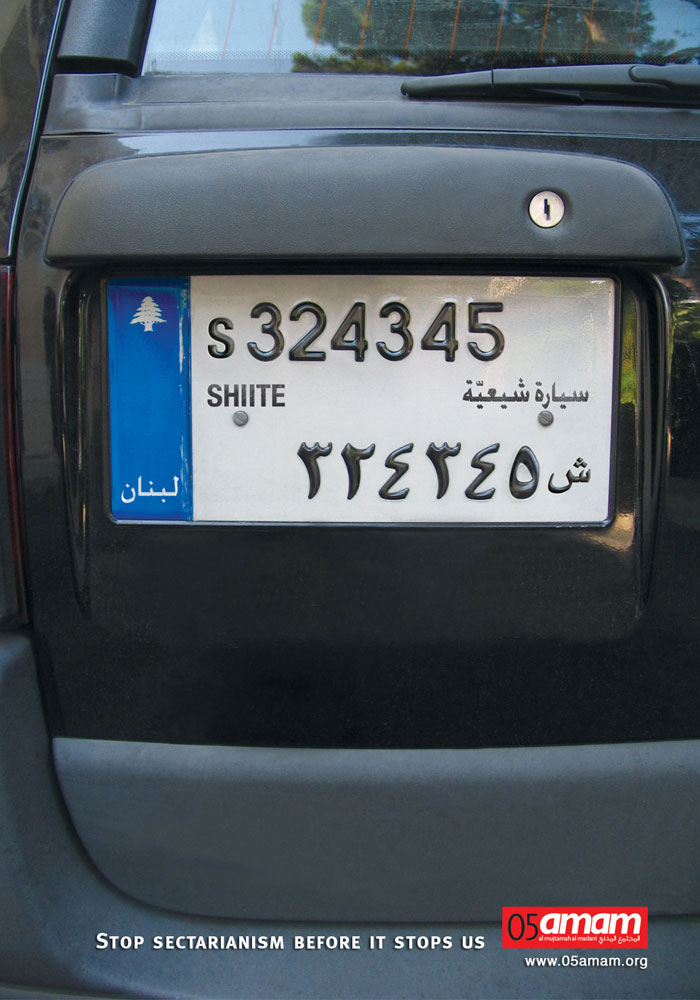
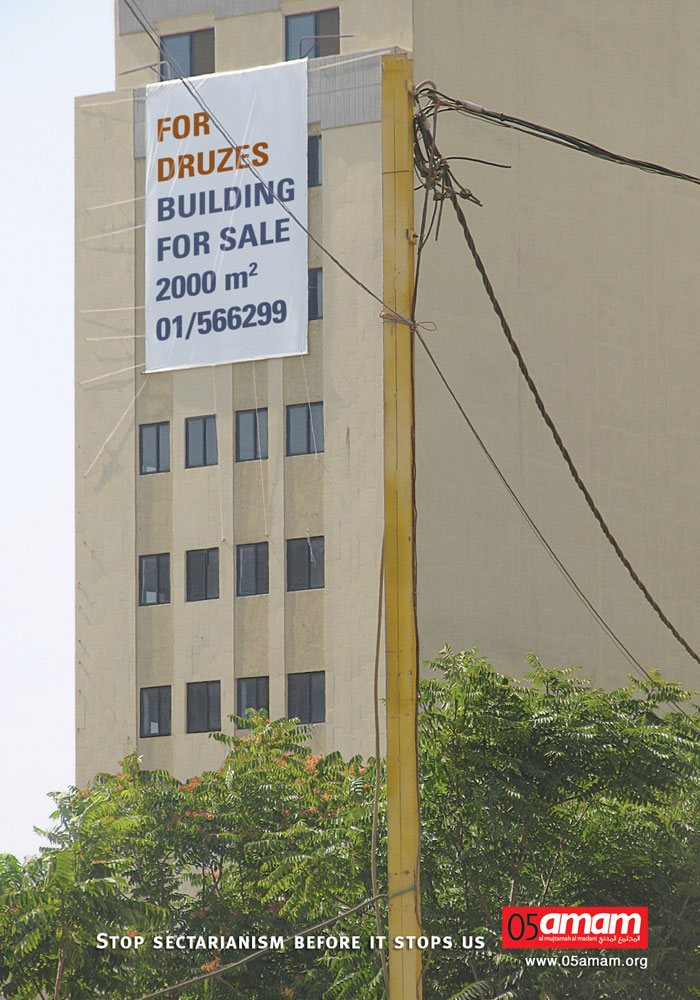
Part provocation, part appeal -- with a dose of farce that doesn't feel all that farcical -- advertisements went up this month on 300 billboards across the Lebanese capital and appeared in virtually every newspaper in the country.

Thousands of e-mails carried the ads across th
e Internet to expatriates. Each offered its take on what one of the campaign's creative directors called a country on the verge of "absurdistan" -- cooking lessons by Greek Orthodox, building for sale to Druze, hairstyling by an Armenian Catholic, a fashion agency looking for "a beautiful Shiite face." At the bottom, the ads read in English, "Stop sectarianism before it stops us," or, more bluntly in Arabic, "Citizenship is not sectarianism."
The campaign, designed for free by an ad agency and promoted by a civil society group, has forced Lebanon to look at itself at a time when the country is spiraling into one of its worst political crises in years. The timing was coincidental, the message universal, in a landscape with ever dwindling common ground: The forces that dragged Lebanon into one civil war are threatening another.

Many have praised the ads for asking uncomfortable, even taboo questions about a system in which sectarian affiliation determines everything from the identity of the president to loyalty to sports teams. Some have mistaken the campaign for reality. Across the capital, one in six billboards was torn down, prevented from being put up or splashed with paint, usually the tactic of choice for conservative Muslims irked by lingerie ads.
"They didn't get it," said Fouad Haraki, a 53-year-old shawarma vendor, idly dragging on a cigarette next to a kerosene tank, across the street from billboards that had been defaced. "They just read what was written on top, not what was on the bottom." The result in his neighborhood, he said, was "a sectarian clamor."
It is almost a cliche that Lebanon is home to 18 religious sects -- from a tiny Jewish community to Shiite Muslims, the country's largest single group. The system that diversity has inspired has delivered minorities a degree of protection unequaled anywhere else in the Arab world. But it has left Lebanon a country where individual rights and identity are subsumed within communities and, by default, the personas of their sometimes feudal leaders, who thrive on that affiliation.
By tradition, the president is Maronite, the prime minister Sunni, the parliament speaker Shiite. Other posts are reserved for Greek Orthodox, Greek Catholic and Druze. Boy scouts are organized by community, not country -- the Mahdi Scouts for the Shiites, for instance. Television stations have their own sectarian bent -- the Lebanese Broadcasting Corp. for Christians, Future for the Sunnis. Christians are partial to the Sagesse basketball team, Sunnis the Riyadi team.

There are even two Armenian soccer teams -- Homenmen and Homenetmen -- one faithful to Armenian leftists, the other to the community's right wing. Before this summer's war, Sunni soccer fans loyal to Ansar brawled in a stadium with Shiite youths loyal to Nijmeh.
The system, known as confessionalism, dates to long before Lebanon's independence in 1943. But there is a growing sense that the decades-old principles underlying Lebanese politics have grown obsolete. In some ways, today's crisis is about the assertion of power -- a coup to its critics -- by the long-disenfranchised Shiite community led by Hezbollah. Hardly anyone can forecast with certainty how the struggle will end, but almost everyone sees it as a turning point, a crisis that intersects raw ambition with ideology, foreign policy, perspective and history, all awash in sectarian combustion.
"This is today a very explosive situation where you have all those sects being triggered, teased and hammered by all their leaders," said Bechara Mouzannar, the regional creative executive director for H&C Leo Burnett in Beirut, which authored this month's ad campaign. He calls himself "a little dazed and confused."
"Something is about to explode, unfortunately," he said.Added his colleague, Kamil Kuran: "If we keep thinking like this, the future is going to look like this."The inspiration for the campaign came almost by coincidence in their cramped offices, its walls cluttered with ads for L&M cigarettes, a poster for the film "Reservoir Dogs" and memorabilia from last year's protests after the assassination of former prime minister Rafiq al-Hariri. Those protest signs appear a little dated; " Independence '05" and "All of us for the nation." On one window hangs a handwritten quote: "The greatest thing to be achieved in advertising, in my opinion, is believability."

Manal Naji, a 27-year-old senio
r art director, had glanced at a r?sum? tucked underneath another piece of paper. "Christian," it read. "We were so shocked," she recalled. In the end, it turned out it was the name of the applicant's father, but it gave Naji an idea. "What if it actually existed," she said. "What if it reached the point of putting it on your job application." "We wanted the same shocking effect," added Reem Kotob, a 25-year-old member of the creative team.
This weekend, the two sat with another member of the team, 26-year-old Yasmina Baz, in the agency's conference room, looking over the ads they designed in a burst of energy on that first night and a later session at a nearby bar, Club Social.

One is a doctor's plate: "Dr. Mohamed Chatila, Muslim Sunni." Another is a three-story banner that reads, "For Druzes, Building for Sale ." A license plate is pictured: "A Shiite car," it says in Arabic, "Shiite" in English. And an ad for a car: "2000 model, in near perfect condition. Owned and maintained by a Maronite. Never driven by non-Maronites."
The team took the ads to Amam 05, a grass-roots group that grew out of last year's protests. The name means "ahead," an acronym of the Arabic for civil society. It states its mission, admittedly ambitious, as "a modern, sovereign state built on non-feudalism, non-confessionalism and non-clientelism." But even its leaders admit to being a little glum, given today's crisis. "Very frustrated," said Nicole Fayad, one of the activists.

The original idea was to actually hang the signs in the city: "Maronites only" in a parking lot, "For Druzes" on the side of a building. But when Asma Andraos, one of the group's leaders, approached the owners, they cringed.
"They called me back, and they said they loved it, that I was crazy, and that there's no way they could do this," she recalled. She shook her head. "If I had a building, I wouldn't have done it, either," she said.

They went instead to newspapers, placing the ads in eight papers for two weeks this month. One printed them for free, the others at a 50 percent discount. A billboard agency agreed to post 300 for free for a week. In all, it cost the group $40,000; Mouzannar estimated it would have cost more than $500,000 commercially.

But before the billboards went up, they had to go through the formality of getting permission from the intelligence branch known as General Security. At first, officials refused; one compared the ads to Nazi-era segregation. It took two hours of face-to-face meetings to reach a resolution, by convincing the officials that the campaign was intended to be ironic.When the billboards went up, 50 were defaced or torn down. Some residents stopped them from going up in the first place. In Lebanon and abroad, e-mails flitted back and forth, some of their authors believing the messages were real."People were seriously panicked," Andraos recalled. "Are there really signs like that in Lebanon now? The mere fact that people think it's possible, that there might be signs like that in Lebanon now, means we're not really that far off."

Members of the group say people have criticized the timing, and the group delayed the campaign's next step after the assassination last week of a government minister, Pierre Gemayel. But they plan to distribute as early as this weekend 15,000 business cards with the same theme at bars and restaurants in Beirut. Each card lists a person's name and religious affiliation. Next, they will send copies of the cards to Lebanon's 128 legislators.

"We want it to be raised as an issue," Fayad said, "but we don't have the pretension to say we have the answer."At a cafe near downtown, Randy Nahle, a 21-year-old student, wondered about the way out. His father is Shiite, his mother Maronite Catholic. The neighborhood he sits in, like virtually every one in Beirut, has its markers: the posters and religious symbols on walls, the muezzin or the church bells that identify its affiliation.

For once, he said, something organized spoke to his rejection of being "categorized or oversimplified."He smiled at his favorite ads, the ones that identified doctors by their sect. "It has infiltrated our fabric so much, almost indelibly," Nahle said. "If I have an earache, an Orthodox doctor will understand it better. It's an Orthodox ear."

He recalled sitting with a Shiite woman at a cafe near the American University in Beirut. She treated him as a fellow Shiite until he revealed his mixed background. She looked at him disapprovingly. It's bad for the children, she said. "They're going to come out confused," she told him.

"I said, 'You know, the problem of this country is we don't have enough confused
people. The problem is we have too many people blindly convinced by their political orientation, by their religion, by their community's superiority.' " She smiled, he recalled, and then laughed a little uncomfortably.

Monday, November 20, 2006

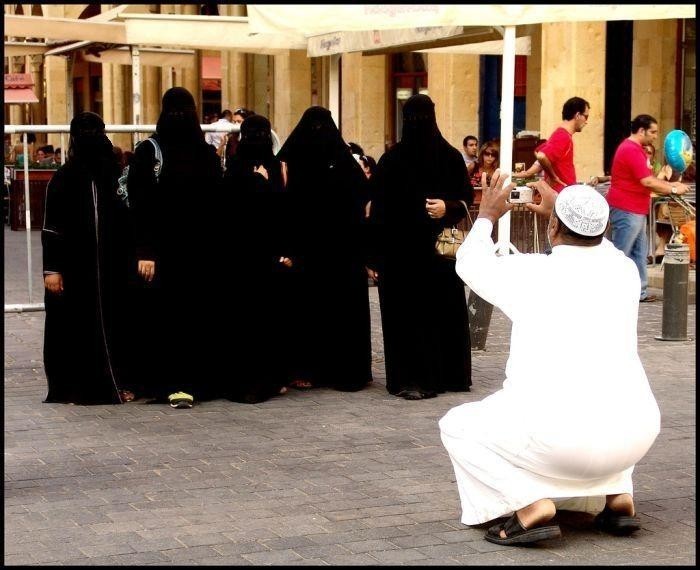
Say Cheese ...Arab style?
Got this picture through my cousin in Surinam.
Looks like it was taken in Downtown Beirut or,
a serious case of Adobe Photoshop.


Friday, November 03, 2006

Hikmat Mahawat Khan, derde op de lijst EenNL

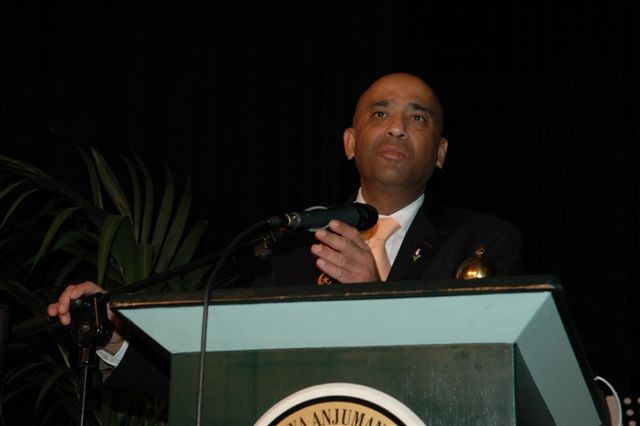
Wat beweegt de Surinaams-Hindostaanse moslim Mahawat Khan om zich aan te sluiten bij een partij als EénNL; een partij die dicht aanschurkt tegen het gedachtegoed van Pim Fortuyn? U weet wel, de man van ‘de islam is een achterlijke cultuur’. Ook zijn huidige partijgenoten als Marco Pastors en Ronald Sörenson zijn regelmatig beticht van racisme en xenofobie. Esther Prade en ik besloten het hem zelf te vragen tijdens een seminar georganiseerd door de Ahmadiyya Anjuman Isha'at Islam (Lahore) Nederland waar Mahawat Khan een inleiding hield met als thema 'de islam terug van risicofactor naar aanwinst'.

Hikmat Mahawat Khan: een bevlogen moslim die ervoor past om als excuus-allochtoon van de partij te worden versleten,
die vindt dat moslims voor een belangrijk deel zelf verantwoordelijk zijn voor de negatieve beeldvorming rondom de islam, die er niet voor terugdeinst om de manco's van zowel allochtoon als autochtoon Nederland te benoemen:

Videofilm Hikmat YouTube of hieronder op de play button van het screenshot klikken.


Hikmat Mahawat Khan werd op 15 juni 1960 in Suriname geboren. Als 18-jarige verliet hij zijn geboorteland om in Nederland Luchtvaart- en Ruimtetechniek en Business Administration te gaan studeren. Hij vervulde diverse functies in de luchtvaart, onder meer bij Air Holland, debis Airfinance en KLM. Momenteel is hij Business Consultant in de luchtvaart.


Sinds 1999 werd Mahawat Khan voorzitter van de Haagse Lahore Ahmadiyya moskee en later ook van landelijke koepel Unie van Ahmadiyya Lahore moskeeën. In 2004 zat hij de Contact Groep Islam (CGI) voor, waarvan hij mede-oprichter is. Vanuit deze organisatie voerde hij overleg met de regering over onderwerpen die met moslims in Nederland te maken hadden. Gedesillusioneerd door de ‘oeverloze discussies’ met de overheid hield Mahawat Khan het in september 2006 als voorzitter CGI voor gezien. Vlak daarna werd bekend dat hij een derde plek had gekregen op de kandidatenlijst van de nieuwe partij EénNL voor de Tweede Kamerverkiezingen 2006.

Foto links boven: Twalieb Hassenmahomed
Video: Esther Prade

Thursday, November 02, 2006

Politics of fear and control

Conference War & Peace: all talk…?

Text and photos by Sharida Mohamedjoesoef for the Amsterdam Weekly

You are either with us or against us’. In these unequivocal terms US president George W. Bush made it quite clear in September 2001 that he expected full support for his so-called War on Terror. Five years on: fierce fighting in Afghanistan, a full-out (civil) war in Iraq, an upsurge of violence in Israel and the Occupied Territories, not to mention the piles of smoking rubble in Lebanon after the drums of war between Israel and Hezbollah.

Only three weeks ago General Richard Dannett of the British forces sparked a row, saying that UK troops were making matters worse in Iraq and should withdraw soon. Would the same be valid for Dutch troops in Afghanistan fighting off the Taliban instead of rebuilding the country? The question is reason enough for organisations like Stop the War Coalition and political party GroenLinks to initiate the national conference War & Peace that was held at Felix Meritis last Sunday.

The circular neo-classical hall was packed with some 150 people who had come to listen to a great number of speeches of, for instance, Hajo Meijer, Auschwitz survivor and secretary to A Different Jewish Voice, and Tariq Shadid, Dutch-Palestinian representative of the Palestinian Community Netherlands.

First-rate crowd-puller, however, was Dyab Abou Jahjah, the charismatic, articulate Lebanese-born president of the Arab European League (AEL). Jahjah is known for his fierce defence of Muslim migrant interests in both Belgium and the Netherlands.

This time he decided to take his captive audience for a stroll through history, illustrating recurrent patterns when it comes to the erosion of civil liberties in favour of the so-called the greater good. Jahjah intones: ‘During the Red Scare communists and sympathisers were victimised in a way that is comparable to the criminalisation of Muslims now. And let’s not forget about one of Europe’s most notorious terror groups: the German Baader Meinhof Gruppe. The German government felt compelled to adopt a series of anti-terror laws that seemed to clash with the democratic principles of post-war Germany in the same way as the anti-war measures are imposed now. The Red Scare has swapped places with the Muslim Threat.’

‘Quite right,’ says Ben Hayes of Statewatch, a British organisation that has been documenting UK laws on policing since 1991. According to Hayes, the British government is taking all kinds of measures under the pretext of security, varying from phone taps to fingerprinting pupils at some 5,000 schools throughout the country: ‘politics of fear and politics of control, two sides of the same coin, and now a complete generation is growing up with the notion that all this surveillance is totally normal.’ Both Hayes and Jahjah feel that Muslim – Arab migrants in particular are bearing the brunt of anti-terror measures after 9/11. The end is nowhere near in sight, Hayes points out, as ‘the UK police model is gradually being rolled out in the rest of Europe.’

‘Don’t expect the Dutch government to turn the tide,’ says senator Anja Meulenbelt with disappointment. She is one of the few politicians present and is not afraid of apportioning blame to all left-wing political parties, including her own Socialist Party. ‘We have failed to stand up against the victimisation of fellow Muslim citizens.’

‘What on earth can we do to bring about change?’, was a frequently heard question in the audience. Surprisingly enough, few, if any, clear-cut answers were given. Jahjah firmly stuck to his guns saying that grassroots activism should do the trick, while Hajo Meijer stressed the importance of exercising maximum pressure on ‘our American puppet government’.

Although their statements were sounding off to an overall sympathetic audience, some dissonant cords were heard: ‘all talk, no action’ and ‘no opposing views from the right-wing camp’. Whether this was due to an unwillingness on the part of the organisers to invite them or ‘typical ostrich behaviour on the Right,’ as some claimed, remained unclear.

Yet, while some speakers did not seem to mind the absence of the Right, others like Tariq Shadid did, Shadid even quoted legendary US president Roosevelt:

‘We have to face the fact that all of use are going to die together,

or we are going to live together.

And if we are going to live together, we have to talk.’

Thursday, October 26, 2006

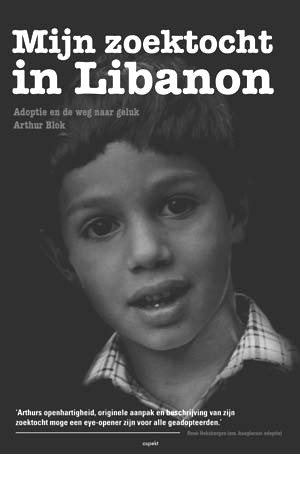
Mijn zoektocht in Libanon

Van een kale hotelkamer met kakkerlakken naar een gezellige familielunch op zondag; van dichte archiefdeuren naar de open Libanese media; van een chaotische wereldstad naar een rustig dorp in het groene Chouf-gebergte.

Mijn zoektocht in Libanon is een fascinerend verslag waarin Arthur Blok vertelt over de bewogen tijd die hij doorbracht in zijn geboorteland. Op zoek naar zijn wortels. Er blijkt een schaduw te liggen over de eerste zes maanden van zijn leven en over de adoptieprocedure. Arthur vertelt over zijn psychische strijd in een ontwrichte en corrupte samenleving, maar ook over het vinden van rust en verzoening met zichzelf.

Mijn zoektocht in Libanon is een betoog over verdriet en pijn, maar ook humor en toeval spelen een belangrijke rol. Tot en met het allerlaatste moment blijft het spannend waar en hoe Arthurs wonderlijke avontuur zal eindigen.

Het boek , ISBN: 9059113756 (prijs 17.95 euro) , is een zoektocht naar zijn eigen geschiedenis en schetst een beeld van de complexe samenleving in Libanon. Meer weten? Stuur dan een email naar: s.mohamedjoesoef@planet.nl

Bravo Arthur! Hope to write many more articles with you on our favourite country Lebanon, Lubnan, Libanon.

Wednesday, October 25, 2006


Cinéma Arabe 2006

Cinéma Arabe is back. From 1-15 November you can enjoy a great selection of films from young, promising filmmakers. This second edition of the Arab film festival centres around two specials, the first one being ‘Cinema & Religion’, containing a number of classical Egyptian films in which religion and the portrayal of the prophet Mohammed play a central role. The second is ‘Al Jazeera Uncensored’, showing various uncensored documentaries from the well-known Arab news channel Al-Jazeera. To top it all, Cinéma Arabe presents ‘Film in de buurt’; taking a beautiful selection of films to several Amsterdam neighbourhoods; no admission fee! The festival kicks off at Film museum Cinerama on 1 November with La Última Luna (The Last Moon), an intriguing story about a complicated friendship between a Jew and an Arab in Palestine, during and after the First World War. For more information, please visit the website: www.cinemaarabe.nl.

Why has Hikmat joined ranks with EenNL?

Want to know why Hikmat Mahawat Khan decided to team up with EenNL, a new right-wing political party which quite a few Muslims regard as racist, xenophobic? A video interview with the man himself will soon be available on this blog...!


Eid Mubarak

By Sharida Mohamedjoesoef, Ramadan Roundup V for the Amsterdam Weekly

Thirty days filled with an odd mixture of contemplation, devotion, will-power, partying and family get-togethers, and, this year, jazzed up with lively debates and lectures on a wide variety of topics related to Islam and Muslims in the Netherlands. In Amsterdam--home to some 120,000 Muslims--alone, over a hundred activities were organised, and those were just official events! All this came to an end last Monday, as Muslims all over the world, from Amsterdam to Zanzibar, took part in the Eid al Fitre celebrations, the feast marking the end of Ramadan, in Dutch better known as the Suikerfeest.

True, a few years ago, one would have needed a magnifying glass to spot any such activity. But then again, a few years ago there was no 9/11, no murder of Theo van Gogh, no reports on the radicalisation of young Muslims and so on. It is events like these that catapulted the Muslim community into action; and not just on the cultural and religious front either, as Dutch Muslims are also becoming increasingly active in the political arena.

Given the upcoming elections on 22 November, one the biggest Turkish organisations in the Netherlands, the Milli Gorus, decided to host an iftar coupled with a debate on the role of Muslims in Dutch politics. One of the speakers was Hikmat Mahawat-Khan. A Muslim of Surinamese descent, Mahawat-Khan knows what it is like to be the topic of debate. He is known for his spicy one-liners and speeches peppered with critical remarks on what he considers to be misbehaviour on the part of Muslims. When news got out that Mahawat-Khan had joined EenNL, a political offspring of Pim Fortuyn's legacy, his critics had a field day, labelling him a traitor serving a xenophobic and racist agenda. Well, you can say many things about him, but a racist he is not.

[For those of you who missed this part of recent Dutch history, the would-be politician Fortuyn called Islam a 'backward culture'. He was brutally murdered in May 2002 by an animal rights activist.]
With hotheaded Mahawat-Khan on the panel, you are usually in for a fiery debate on integration and participation. And sure enough, I was not disappointed. Loud grunts of disapproval rippled through the audience as he was off on his hobby-horse again, saying things like 'integration has failed' or 'Muslims themselves are in part responsible for the fact that they are being discriminated against on the Dutch labour market.'

Yet what would have been an absolute no-can-do a couple of years ago, finally seems to be taking root: criticism from within the Muslim community, from the new Milli Gorus foreman, Yusuf Altuntas to Mohammed Ousala, a prominent member of the Dutch Association of Imams. Truly unique, given the fact that those two organisations are all-Sunni, while Mahawat-Khan belongs to the Lahore Ahmadiyya movement and is thus considered a heretic by various Muslim groups.


Be that as it may, more and more prominent Muslims at least seem to have cottoned on to the fact that postmodern gibberish (read: politically correct remarks) or jihad-denial will not solve the problem of polarisation. They will have to address this issue in their mosques and Islamic cultural centres and make their fellow Muslims understand that they and they alone can change the image of Islam. During this year's Ramadan, Muslims more than ever seized the opportunity to counteract the message of violence and hatred spread by the Bin Ladens of this world. But it's only a first step comprising thirty days. What about the remaining 335 days? Now there's challenge for us, if ever you saw one...
From your Ramadan reporter: Eid Mubarak, Happy Eid!


Wednesday, October 18, 2006

'The greatest poverty is the lack of intelligence'

By Sharida Mohamedjoesoef, Ramadan Roundup IV for the Amsterdam Weekly


This time, no story from a stately canal house, a state-of-the-art glass terminal or some posh theatre. And no big wigs or cameras in sight either for, this time, your rambling Ramadan reporter set out for De Baarsjes, home to many Muslims and referred to by some as 'Casablanca aan de Amstel'.

The sun had already set when I finally arrived at my destination, a small community centre near Mercatorplein. Dozens of people of various age groups and ethnic backgrounds were merrily chatting away while waiting for the debate to start. Insofar as I'm concerned, the organisation deserves full marks for its choice of topic for the debate: religion and culture. True, it was noisy, if not chaotic, at times but at least there were hardly any politically correct speeches.

The panel consisted of five people, each representing one of the three main monotheistic traditions: Judaism, Christianity and Islam. Hats off to the only woman on board, Maimunah van der Heide; without getting down to the theological nuts and bolts, she still made it quite clear that many Muslims often mix religion up with culture and that cultural practices are more and more being elevated to the level of religion. 'Don't be fooled by Koranic literates or people dressed in Islamic attire. That's just the outside and certainly no claim to sainthood,' she said.

Black-veiled Van der Heide knows what she's talking about. She converted to Islam when she was in her teens and began spending her life in the service of her new found religion. Eventually, Van der Heide set up an organisation called Stichting Vangnet [safety net], a centre for Muslim girls who are in some kind of trouble. Vangnet was first housed in a mosque, but was forced to relocate because the mosque was first and foremost a house of prayer, or so mosque leaders believed.

Van der Heide as well as the other panelists knew their religious ABC, but the fact is that ordinary believers often do not. Big deal, you might think, but it's a different story altogether when you're Muslim and find yourself and/or your religion subject to scrutiny. There is no denying that much of the current focus on Muslims and Islam was brought about by the events of 9/11. Overnight, the Koran became an instant bestseller. But the Koran, even in translation, is not an easy book to understand, so, if you want more information, it is only logical that you start looking elsewhere.

Ay, there's the rub: ever wondered what happens if clueless non-Muslims start taking their cues from the equally clueless young secular Mohammads and Fatimas from the local shop around the corner, or from radical Islamic websites? For one thing, you could end up with a teacher at an ordinary secondary school telling you that, according to Islam, only girls have to stay virgins or that according to that same religion, newly weds must show a bloodstained sheet after their wedding night to prove that the bride really was a virgin. Speculation? I wish... There's at least one school here in Amsterdam where the above is actually the case. Their handouts did not contain a single clue as to the source of such statements.Quite painful, given the fact that in the Netherlands we now have around 30 Islamic schools, two Islamic universities and even two advisory governmental bodies on Islamic issues. And still we are a far cry from having some kind of uniform quality code for comprehensive, reliable sources on Islam!

P.S. you can search the Koran all you want and still you won't find any verses acknowledging any of the above as proper Islamic conduct.